
IVF-RaBitQ has been made public on arXiv
We are pleased to announce that our paper “GPU-Native Approximate Nearest Neighbor Search with IVF-RaBitQ: Fast Index Build and Search” is now publicly available on arXiv!
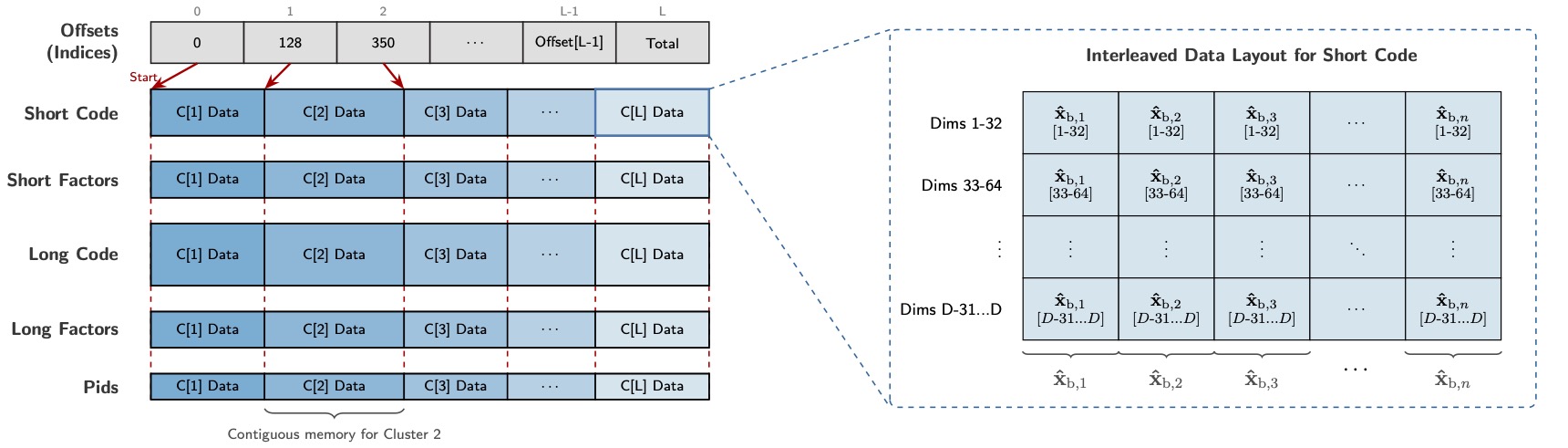
Approximate nearest neighbor search (ANNS) on GPUs is gaining increasing popularity for modern retrieval and recommendation workloads that operate over massive high-dimensional vectors. Graph-based indexes deliver high recall and throughput but incur heavy build-time and storage costs. In contrast, cluster-based methods build and scale efficiently yet often need many probes for high recall, straining memory bandwidth and compute. Aiming to simultaneously achieve fast index build, high-throughput search, high recall, and low storage requirement for GPUs, we present IVF-RaBitQ (GPU), a GPU-native ANNS solution that integrates the cluster-based method IVF with RaBitQ quantization into an efficient GPU index build/search pipeline. Specifically, for index build, we develop a scalable GPU-native RaBitQ quantization method that enables fast and accurate low-bit encoding at scale. For search, we develop GPU-native distance computation schemes for RaBitQ codes and a fused search kernel to achieve high throughput with high recall. With IVF-RaBitQ implemented and integrated into the NVIDIA cuVS Library, experiments on cuVS Bench across multiple datasets show that IVF-RaBitQ offers a strong performance frontier in recall, throughput, index build time, and storage footprint. For Recall approximately equal to 0.95, IVF-RaBitQ achieves 2.2x higher QPS than the state-of-the-art graph-based method CAGRA, while also constructing indices 7.7x faster on average. Compared to the cluster-based method IVF-PQ, IVF-RaBitQ delivers on average over 2.7x higher throughput while avoiding accessing the raw vectors for reranking.